
Everyone Is Talking About AI Agents. But What Should We Actually Build With Them?
AI beyond the hype — identifying problems that genuinely benefit from agentic AI.
Aug 29, 2026·8 min read
 8 min read
The AI Agent Conversation Is Everywhere
There is a new phrase showing up in almost every technology conversation: AI agents. Startups are building them. Enterprises are experimenting with them. Developers are creating frameworks for them. Investors are paying attention to them. And understandably so. For years, much of the conversation around artificial intelligence was centred on systems that could generate things: text, images, code, audio and increasingly sophisticated responses. AI agents introduce a slightly different possibility. Instead of simply asking an AI a question and receiving an answer, we can give an AI system a goal and allow it to take a series of actions toward completing that goal. That sounds exciting. But it also creates a problem. The fact that we can build an AI agent does not necessarily mean that we should. This is where the conversation needs to move. The important question is no longer simply: “What can we build with AI agents?” It should be: “What problem is actually worth giving an AI agent to solve?”
An AI Agent Is More Than a Chatbot
A traditional chatbot is primarily designed to respond. You ask a question. It generates an answer. You might ask it to summarise a document, explain a concept or write an email. The interaction generally begins and ends with the conversation. An AI agent can go further. An agent can be designed to reason about a task, make decisions, use tools, interact with software and take actions in pursuit of a particular goal.
For example, imagine telling an AI system: “Find three suitable meeting times for the team next week, check everyone’s calendars, identify the best option and send a meeting invitation.”
A basic chatbot might tell you how to do this. An agent could potentially do it. It could access the relevant calendars, compare availability, make a decision based on the instructions it has been given, create the calendar event and send the invitation.
A chatbot primarily gives you information. An agent can be designed to help execute the work.
From Answering Questions to Doing Work
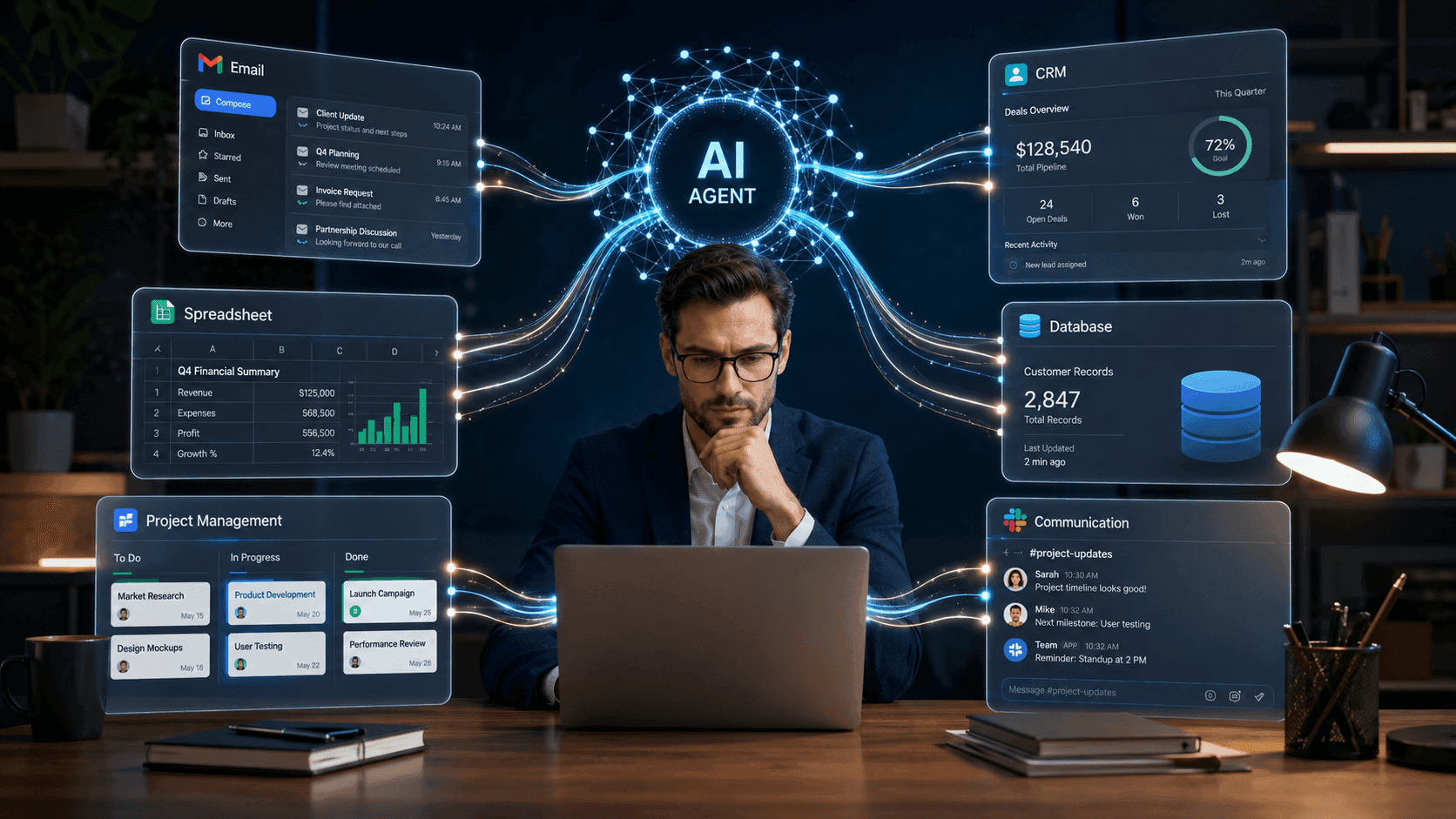
This ability to interact with tools is one of the most important characteristics of agentic AI. An agent might be connected to:
- Email platforms
- Customer relationship management systems
- Spreadsheets
- Databases
- Project management software
- Internal company systems
- Web browsers
- Communication platforms
- Financial or reporting tools
This means an agent doesn’t necessarily have to exist as another chatbot sitting inside a company’s workflow. It can become part of the workflow itself.
Consider a customer support team. A customer sends a complaint about a delayed order. Instead of simply generating a suggested response, an AI agent could potentially:
- Identify the customer.
- Retrieve the order information.
- Check the delivery status.
- Determine whether the order qualifies for compensation.
- Update the relevant system.
- Draft or send an appropriate response.
- Escalate the case if it falls outside predefined rules.
That is a very different proposition from asking an AI to write an email. The value isn’t in the conversation. The value is in completing the workflow.
So, What Should We Actually Build?
This is where businesses need to become more deliberate. Not every task needs an AI agent. In fact, some tasks probably shouldn’t be automated at all. If a process takes two minutes, happens twice a month and requires significant oversight to automate, building an agent for it may create more complexity than value. The better candidates tend to have certain characteristics.
Repetitive Workflows
If employees repeatedly perform the same sequence of tasks, there may be an opportunity for an agent to take over some or all of that process. Think about a business receiving hundreds of similar enquiries every week. An agent could classify incoming requests, retrieve relevant information, prepare responses and route unusual cases to the appropriate employee.
The objective isn’t to replace the employee. It is to remove repetitive work that prevents the employee from focusing on higher-value work.
Multi-Step Processes
Some tasks are difficult not because any individual step is particularly complicated, but because there are many steps involved. Research is a good example. A person might need to search multiple sources, collect information, compare findings, organise the results and produce a report. An agent can potentially coordinate these steps as part of a single workflow.
This is where agentic systems become particularly interesting. They can move from:
“Give me an answer.”
to:
“Work through this process and give me the result.”
Work That Involves Multiple Tools
Businesses rarely operate from one software platform. A single workflow might require an employee to move between email, spreadsheets, a CRM, a project management platform and internal databases. Every switch creates friction.
An AI agent that can interact with multiple systems could potentially connect these fragmented processes. For example, a sales agent could receive a new lead, check the company’s CRM, research the prospect, update the lead record, prepare a personalised follow-up and notify the sales representative. Instead of employees constantly moving information from one system to another, the agent becomes the connective tissue between those systems.
Service Delivery & Operations May Be One of the Biggest Opportunities
Customer-facing operations and service delivery across multiple industries represent significant opportunities for AI agents. But again, the goal shouldn’t simply be: “Let’s put an AI agent on customer support because everyone is doing it.” The better question is: Which parts of service delivery and operations are predictable enough to automate, while still allowing humans to handle situations that require judgement, empathy or escalation?
An agent could handle routine requests such as checking order statuses, updating customer information, answering common questions or initiating standard processes. More complex situations can then be transferred to a human. This principle applies broadly across industries:
- A customer support team managing complaints and inquiries
- A financial institution processing documentation and claims
- A logistics company managing order tracking and shipment updates
- A growing digital business handling account management and billing queries
This creates a model where AI handles the predictable and humans handle the exceptional. That distinction matters. Because good automation doesn’t remove humans indiscriminately. It puts human attention where it matters most.
Research Is Another Strong Candidate
Research-heavy workflows are particularly interesting because they often involve several connected activities. A researcher might need to: Find → filter → compare → analyse → organise → summarise.
An AI agent could potentially assist across that entire chain. For a company, this might mean:
- Monitoring competitors
- For a financial team, tracking market information
- For a communications team, monitoring industry news and identifying emerging conversations
- For a product team, gathering and synthesising customer feedback
The opportunity is not simply generating a summary. It is reducing the amount of manual work required to move from information to insight.
But Don’t Automate Just Because You Can
This is perhaps the most important part of the conversation. Technology has a tendency to create its own momentum. Once something becomes possible, organisations can start looking for excuses to use it.
We saw this with mobile apps.
We saw it with blockchain.
We saw it with countless other technologies.
And AI agents could face the same problem. A company might build an agent because it sounds innovative, only to discover that the underlying process was already inefficient.
Automating a bad process doesn’t necessarily make it a good process.
Sometimes, you don’t need an AI agent. You need to fix the workflow first. Before building an agent, businesses should ask:
- What problem are we solving?
- How often does this problem occur?
- How much time does it currently consume?
- What does the process cost?
- What happens when something goes wrong?
- Can the process be standardised?
- What level of human oversight is required?
- What data and systems would the agent need access to?
- How will we measure whether the agent is actually creating value?
These questions may sound less exciting than talking about autonomous AI. But they are far more important.
Start With the Outcome, Not the Technology
A useful way to think about AI agents is to work backwards. Don’t start with: “We need an AI agent.” Start with: “We need to reduce the time it takes to complete this process by 60%.” Then investigate whether an AI agent is the best way to achieve that outcome.
Maybe it is.
Maybe a simpler automation tool would work.
Maybe the process needs to be redesigned first.
Maybe the task requires too much human judgement to safely automate.
The technology should serve the objective. Not the other way around.
The ROI Question
For businesses, experimentation is important. But experimentation cannot be the final destination. At some point, every AI project has to answer a very traditional business question: Is this actually worth it?
An AI agent might:
- Save employees ten hours every week
- Reduce customer response times
- Increase the number of enquiries a support team can handle
- Reduce operational errors
- Help employees spend more time on strategic work
These are measurable outcomes. And that is where the real value lies. The most successful AI implementations may not necessarily be the ones that look the most impressive in a demo. They may be the ones that quietly save a company thousands of hours every year.
The best AI agent might be the one customers never know exists.
What This Means for African Businesses
For businesses across Africa, this conversation is particularly relevant. There is understandable excitement about AI’s potential to transform industries across the continent. But African businesses also operate within unique constraints.
- Infrastructure varies
- Data quality can be inconsistent
- Many organisations still rely on fragmented or manual processes
- Technology budgets are not unlimited
- Businesses cannot afford to spend heavily on technology simply because it is fashionable
This makes the problem-first approach even more important. African businesses don’t need to build the largest number of AI agents. They need to identify the problems where AI can create meaningful, measurable value.
That might mean:
- Helping a logistics company manage repetitive operations
- Helping a financial institution process large volumes of documentation
- Improving customer support for a growing digital business
- Helping small businesses automate administrative tasks they currently perform manually
The opportunity is enormous. But opportunity without focus can quickly become waste.
The Future Won’t Belong to the Companies With the Most Agents
The AI agent conversation is still developing. New models will become more capable. Tools will become easier to connect. Agents will become better at handling increasingly complex workflows.
But as the technology improves, the organisations that benefit most may not be those rushing to deploy agents everywhere. They will be the organisations asking better questions.
Which problem matters?
Why is it worth solving?
Is an agent the right solution?
What happens if it works?
And perhaps most importantly:
How will we know that it worked?
The real promise of AI agents isn’t that businesses can suddenly make software behave like employees. It is that businesses can rethink how work gets done. That is a much bigger opportunity.
Because the future won’t belong to businesses that use the most AI agents. It will belong to businesses that know which problems are worth giving them.