He Built a Spelling Game You Play With Your Hands in Thin Air
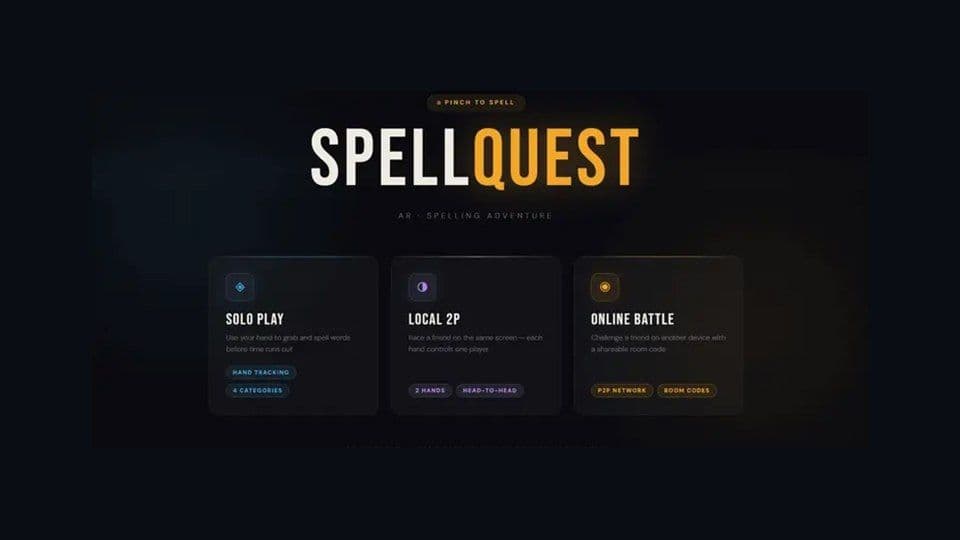
Most spelling apps ask a child to tap a screen. SpellQuest AR asks them to reach into the air and catch letters with their hands. David Aroh built this, alone, and it is one of the most genuinely creative projects to come out of RIL.
Jul 10, 2026·6 min read
 6 min read
He Built a Spelling Game You Play With Your Hands in Thin Air
There is a problem with the way most children learn to spell, and it is not the words themselves. It is the method.
A child sits in front of a screen, taps letters in a sequence, gets a tick or a cross, and moves on. The experience is passive. The body is completely uninvolved. The feedback is binary. And the child who struggles does not get a different explanation or a different approach. They get the same screen, the same format, the same sequence, until they either get it or they do not.
For a generation of children who have grown up in a world of touchscreens and short attention spans, passive learning is the fastest way to lose them before the lesson even begins. The problem is not that children cannot learn to spell. The problem is that the way we have been asking them to do it does not match the way they actually engage with the world around them.
David Aroh noticed this. And instead of writing about it, he built a solution.
What SpellQuest AR Actually Is
SpellQuest AR is an augmented reality spelling game that uses hand-tracking to turn spelling into a physical, interactive experience. To spell a word, a child does not tap a screen. They reach into the air, use their actual hands, and catch or arrange letters that exist in augmented space in front of them. The game tracks their hand movements in real time and responds accordingly.
Spelling becomes something you feel, not just something you see.
The difference is not cosmetic. When a child physically reaches for a letter, positions it, and places it in sequence to form a word, they are engaging a completely different set of cognitive and physical processes than when they tap a button. Their whole body is involved. Their attention is not fighting the screen. It is directed by the screen, outward into the physical world around them.
David built it alone.
The Technology Behind the Magic
SpellQuestAR is built using MediaPipe, Google's open-source framework for real-time hand and body landmark detection. MediaPipe identifies the position and movement of a hand with remarkable precision, tracking individual joints and fingertips across video frames without any specialist hardware. A standard phone camera is enough. No gloves, no sensors, no external tracking equipment, no expensive setup.
This matters enormously in the Nigerian context. A product that requires specialist hardware is a product that will never reach the children who need it most. Schools in Port Harcourt and across the Niger Delta are not equipped with VR labs or motion capture systems. Most families own a smartphone. Some families own a tablet. Very few own anything more sophisticated than that.
By grounding SpellQuest AR in a camera-only technology stack, David made a deliberate decision about who his product was actually for. He was not building a showcase. He was not building a proof of concept for a well-funded lab. He was building for a child in a Port Harcourt classroom, on their parent's Android phone, in the middle of a homework session. If a child has a phone, they can play.
The AR layer itself overlays interactive letter elements onto the real world that the camera captures, blending what the child sees physically with the digital game space. When a letter appears in the air in front of you, it does not feel like a game graphic. It feels like something real that you can touch. Hand movements are detected, interpreted, and translated into in-game actions almost instantly. The result is an experience that feels almost magical the first time you see it, but is built on rigorous, well-understood technology applied with genuine creativity and very clear intention.
Why This Matters for How Children Learn
The research on kinesthetic learning, the idea that physical movement reinforces memory and comprehension, is not new. Educators have understood for decades that children who learn by doing retain information more deeply than children who learn by watching or reading alone. The challenge has always been bringing that insight into scalable, accessible learning tools rather than keeping it confined to expensive hands-on classroom activities.
What is new is making kinesthetic learning accessible in a mobile, camera-based application that costs nothing to run, requires no specialist setup, and can be deployed on any Android phone.
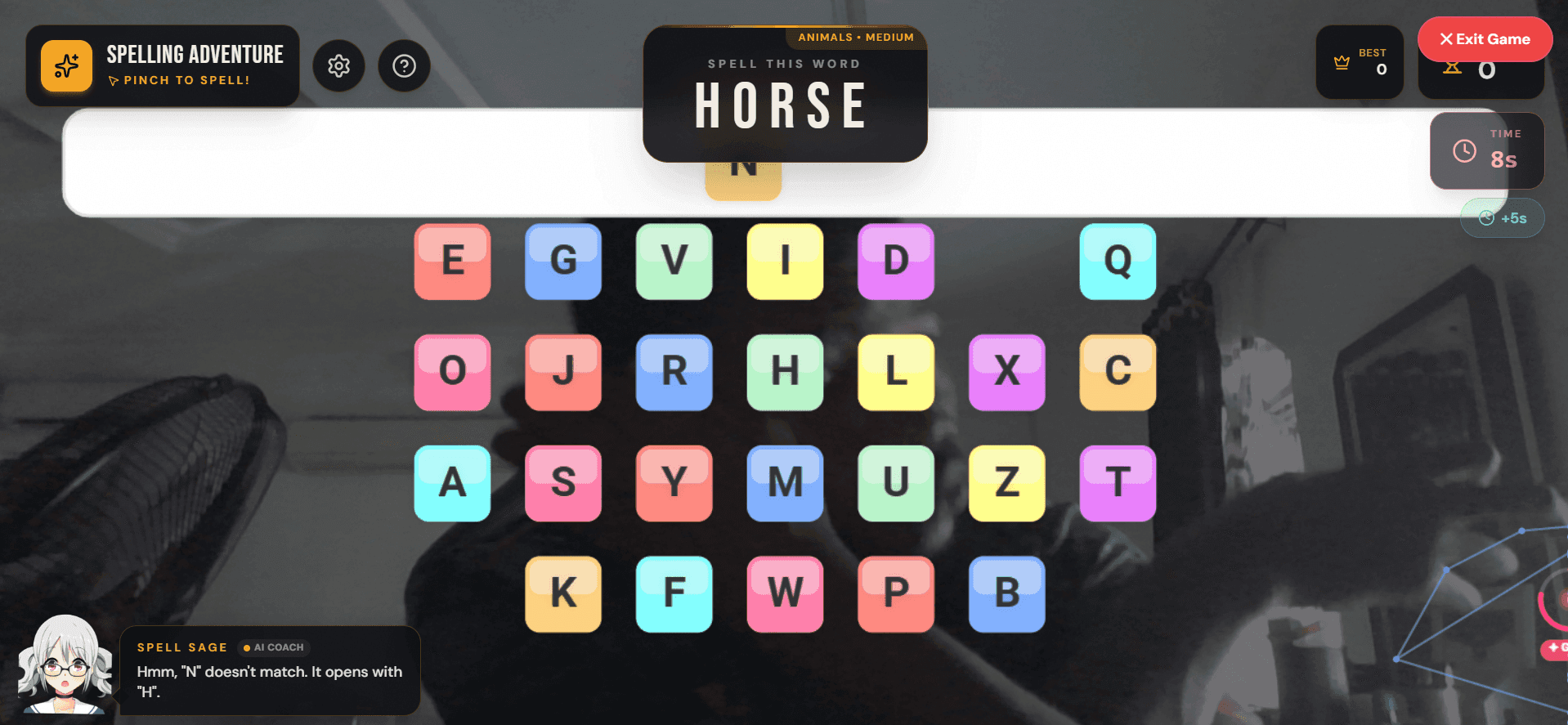
Children who struggle with traditional spelling methods often do so not because they lack intelligence or effort but because the traditional methods simply do not match the way they process information. Some children are visual learners. Some are auditory. But a significant number learn best when their bodies are involved, when they are doing something physical with the information they are trying to absorb. For those children, tapping a letter on a flat screen produces a completely different cognitive experience than reaching into space and physically placing that letter with their hands.
SpellQuest AR offers a fundamentally different engagement model for exactly those children. The act of physically reaching for a letter, orienting it, placing it in sequence, repeating that action across multiple words across multiple sessions, creates a multi-sensory memory trace that passive tapping simply does not produce. The word lives not just in the child's memory of seeing it but in the memory of their hands having formed it.
For teachers and parents in Nigeria working with limited budgets and limited access to specialist educational technology, a free, camera-based AR spelling game on a standard smartphone is not a novelty. It is a genuinely useful tool that addresses a real gap in the learning experience for children who have not been well served by existing approaches.
A Different Way of Thinking About EdTech
Most educational technology in Nigeria is built around content delivery. It takes what a teacher would say or what a textbook would show and puts it on a screen. That is valuable. Access to content matters enormously in a system where qualified teachers are stretched thin and resources are unevenly distributed.
But SpellQuest AR is not content delivery. It is engagement redesign. It does not just change where a child accesses spelling practice. It changes what spelling practice actually feels like and what it asks of the child's brain and body. That is a fundamentally harder problem to solve, which is part of what makes David's approach so interesting.
He did not start with a technology and ask what education problem it could solve. He started with the way children actually learn, recognised a gap between that and the tools available to them, and then found the technology that could close the gap without requiring anything the children or their families do not already have.
That sequencing, problem first, technology second, is rarer in EdTech than it should be. And it shows in the product.
Built in the Lab, For the Community
SpellQuest AR was built inside Renaissance Innovation Labs, in a community that pushes builders to think about real problems for real people. David is not an exception to the kind of builder RIL produces. He is an example of what the lab is designed to create: someone who sees a genuine gap, has the technical skills to build something that addresses it, and is surrounded by the kind of community and infrastructure that makes shipping possible.
The lab did not give David the idea. It gave him the room to develop it into something real.
SpellQuest AR is a reminder that the most meaningful applications of emerging technology are often the ones aimed at the smallest and most overlooked users. Children learning to spell in Port Harcourt are not the target audience most AR developers think about. Most AR development is aimed at enterprise use cases, gaming for global markets, or industrial applications. The child who is struggling with spelling in a Nigerian primary school is not on most roadmaps.
David put them on his.
And he built something for them that nobody else had built, with tools they already own, in a language their hands understand, because he believed that technology should serve real people in real places, not just the ones who can afford the premium version.
If you are an educator, a parent, a developer, or simply someone who believes that, SpellQuest AR is worth paying attention to. Not because it is perfect, but because it is proof that a single builder with a clear problem, the right tools, and a community behind them can create something that genuinely expands what learning can feel like.