When the Mic Shook and She Didn't: Taiwo Kolawole's Thread Flow Moment
Before Taiwo Kolawole ever touched the mic, she almost walked away. This is the story of the tears, the pitch, the community that held her up, and the platform that made a room believe fashion houses deserve better tools.
Jul 02, 2026·14 min read
 14 min read
There is a particular kind of courage that has nothing to do with confidence. It looks, from the outside, like hesitation. It sounds like a voice catching in the middle of a sentence, a breath taken too quickly, a hand tightening around a microphone as if the microphone itself might steady the person holding it. It is the courage of the person who is terrified and stays anyway. And on the afternoon of June 26th, at the June Innovation Workshop inside Renaissance Innovation Labs, that courage had a name.
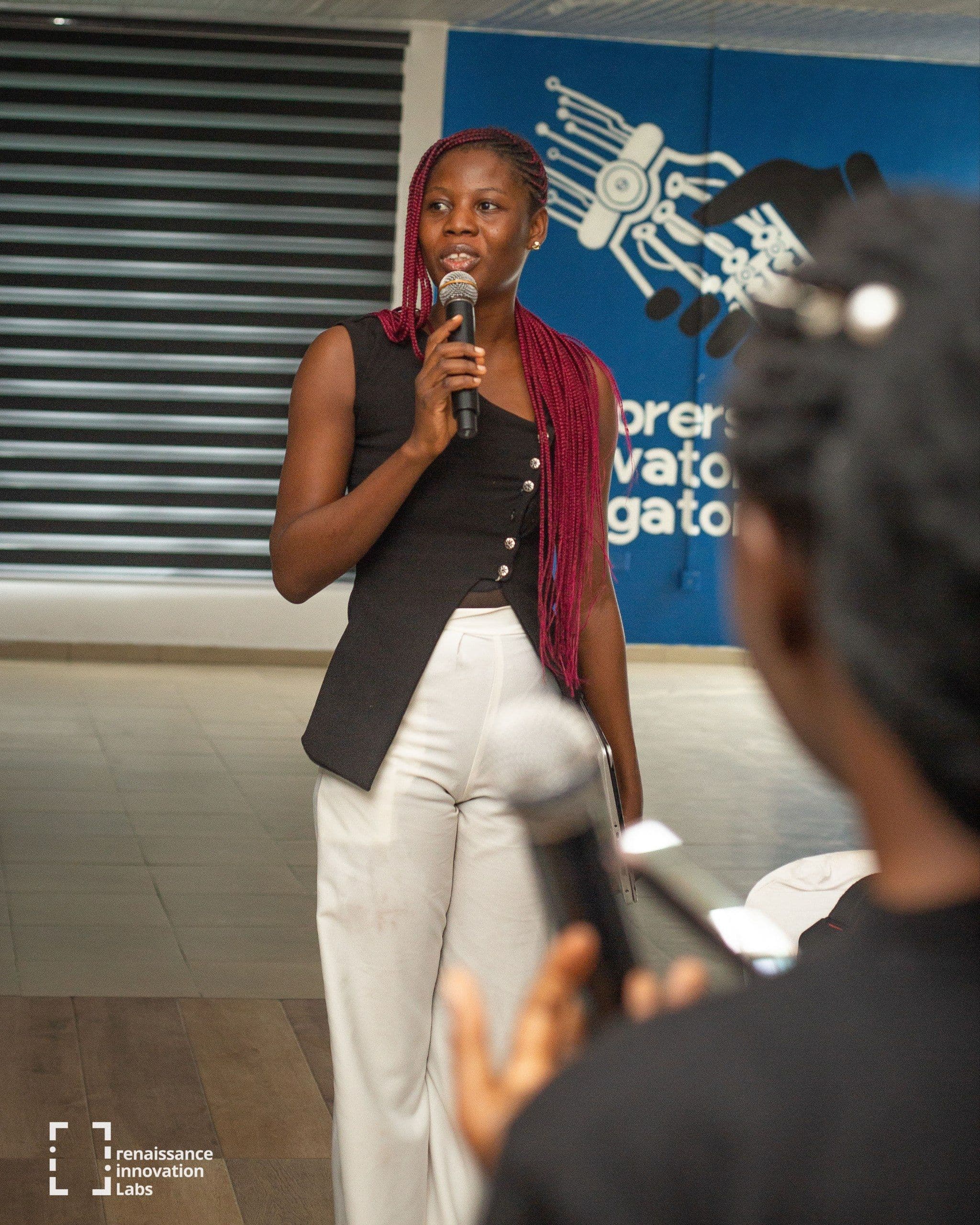
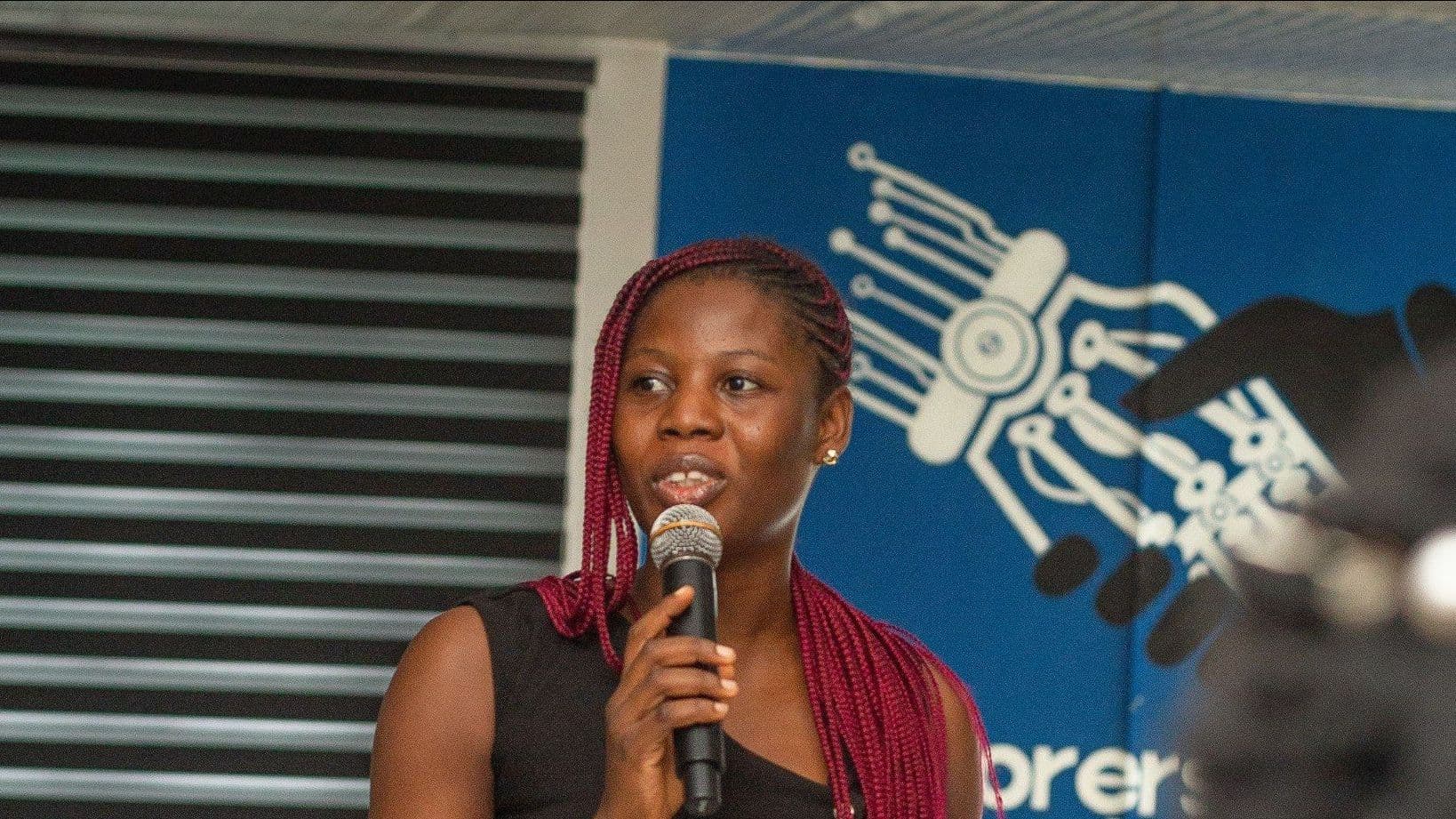
Her name is Taiwo Kolawole.
She stood at the front of the room and told the story of a platform she had built called Thread Flow, and she told it with tears running freely down her face, and she refused to stop talking. This is that story. But like every story worth telling, it doesn't begin where you think it begins. It doesn't begin at the microphone. It begins in the corridor, before the lights, before the audience, in the small and private moment where a person decides whether or not they are brave.
The Corridor
Before the event, she found me.
There is a version of every big day that nobody photographs. The version before the ring light goes on, before the chairs fill, before the projector hums to life and someone taps a mic and asks if it's working. That is where I met Taiwo that afternoon. Not on the stage, but in the quiet just outside it, where the noise of the room is a muffled thing behind a door and your own heartbeat is suddenly the loudest sound in the building.
She was quiet. Almost apologetic. And she told me she wanted to pull out.
I have heard this sentence before, from more people than I can count, in more corridors than I can remember. Stage fright is not rare. What is rare is being honest about it out loud, to another person, while there is still time to run. Most people who want to quit don't tell you. They just disappear, and you find out later, and by then it's too late to say the thing that might have changed everything. Taiwo told me. That, on its own, was already a kind of bravery she didn't know she was showing.
I told her to stay.
I did not tell her she would be fine. I could not promise her that, and she would have known if I were lying. What I told her instead was closer to the truth: that some presentations are not really about the slides at all. They are about a person deciding, in real time, in front of everyone, whether the thing they built with their own hands is worth the discomfort of being seen. I told her that I believed hers was. And I told her something that I have come to believe is the whole reason a place like Renaissance Innovation Labs exists in the first place: that she would not be up there alone. That the room she was afraid of was not a room of strangers waiting for her to fail. It was a room of her people, waiting for her to succeed.
I don't know if she believed me in that moment. I'm not sure I would have, in her shoes. But she nodded. And she stayed.
What a Community Actually Is
It is easy to say the word community. Every hub, every co-working space, every startup with a Slack channel says it. The word has been used so often that it has almost stopped meaning anything. But I want to tell you what it actually looked like that day, in specific, concrete terms, because Taiwo's story does not make sense without it, and neither does Renaissance Innovation Labs.
Her friend Josephine was there. This matters more than it sounds. When you are about to do the hardest thing you've done all year, the presence of one person who knows you, who has seen you at your most ordinary and still shows up for your most frightening moment, changes the physics of the room. Josephine did not have to say anything profound. She just had to be there, in a seat Taiwo could find with her eyes if she needed to. And she was.
Mr. Godfrey, one of the judges, watched from the panel with the kind of attention that a nervous speaker can feel even without looking. There is a difference between being judged and being witnessed, and the best judges understand it. Mr. Godfrey was there to evaluate a product, yes, but he was also there, like everyone else in that room, as a witness to a person trying.
And then there was Mr.Boma Amakri
I will come back to him, because what he did that day is the hinge on which this entire story turns. But first, understand the shape of the room Taiwo walked into. It was not a tribunal. It was a community that RIL had spent months building on purpose, deliberately, one Friday Fun at a time, one workshop at a time, one late evening of people helping each other debug and rehearse and rewrite at a time. By the time Taiwo stepped up to that microphone, the ground beneath her had already been prepared by dozens of small acts of belonging she probably never even noticed. That is what a community is. It is the invisible floor you don't know is holding you up until the moment you need it to.
This is the part of RIL that doesn't fit neatly into a metrics dashboard. We can count attendees. We can count projects shipped, workshops held, builders onboarded. What we cannot easily count is the thing that made Taiwo stay in that corridor instead of walking out the front door. That thing has no unit of measurement. But it is the most valuable thing we have.
The First Sentence
When they called her name, she walked to the front.
I have watched a lot of people make that walk. It is a longer distance than the floor plan suggests. Every step is a small negotiation with yourself. And when Taiwo reached the front and turned to face the room, you could see the negotiation was not yet finished. Her hands were not still. Her breath was high in her chest. She opened her mouth to begin, and the first sentence came out fragile, on the edge of breaking.
And then it broke.
The tears came. Not the delicate, controlled kind that a speaker can blink away and continue past. The real kind. The kind that comes when something you have carried privately for a long time is suddenly standing in a lit room in front of everyone, and there is nowhere left to hide it. She was talking about a problem she understood not from a market research report but from somewhere much closer, and the closeness of it caught up with her right there at the microphone.
Here is the detail I want you to hold onto, because it is the whole thing: she was not shocked by her own tears.
She knew. Somewhere in her, she must have known this story lived close to something real, and she had chosen to tell it anyway, knowing what it might cost her composure. That is not weakness. That is the opposite of weakness. Weakness is telling the safe version of the story, the one that keeps your voice steady because it keeps your heart at a distance. Taiwo told the true one. And the true one made her cry.
The room went very quiet. Not the awkward quiet of people who don't know where to look. A held quiet. The quiet of a room that has collectively decided to lean in rather than look away.
The Hinge
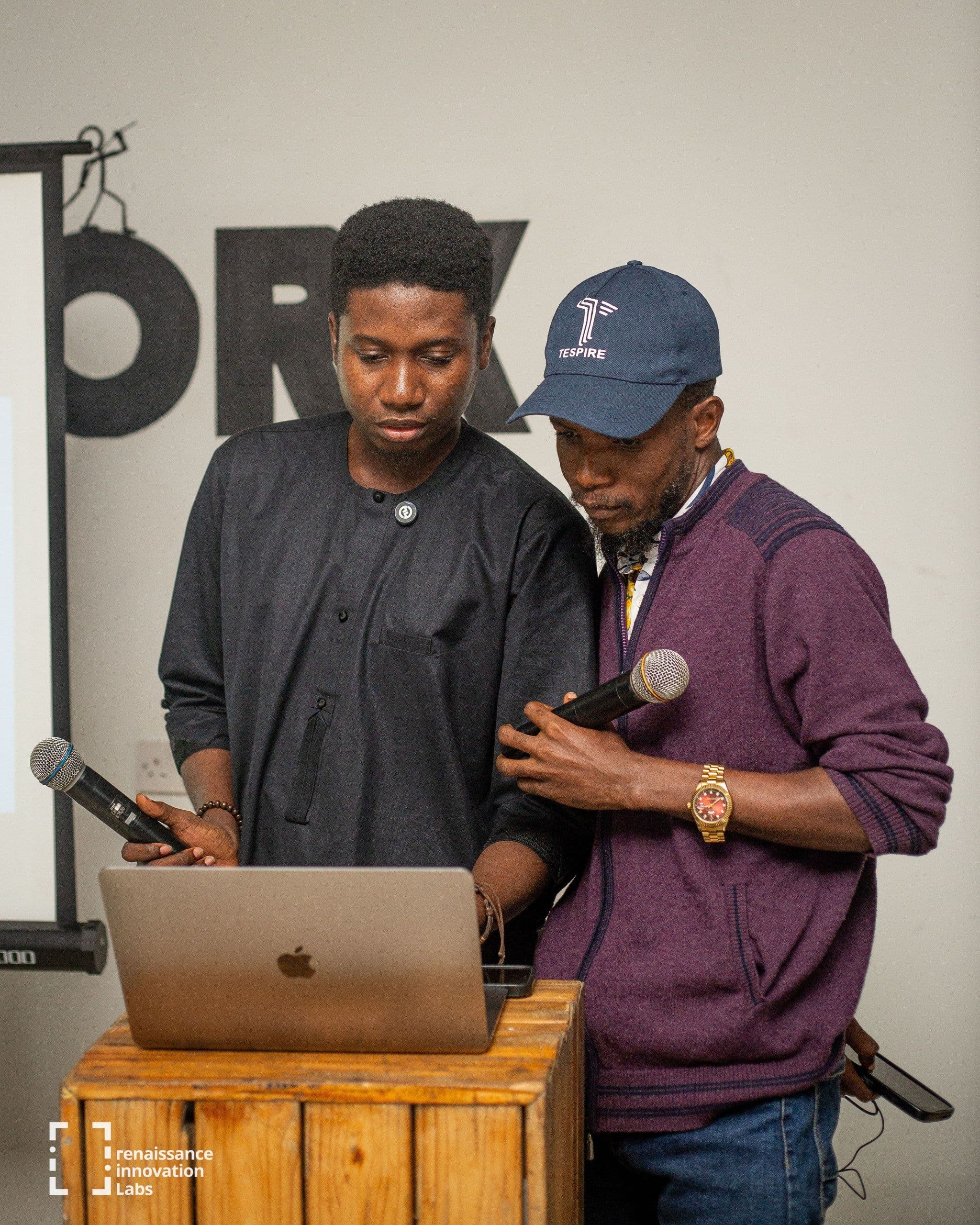
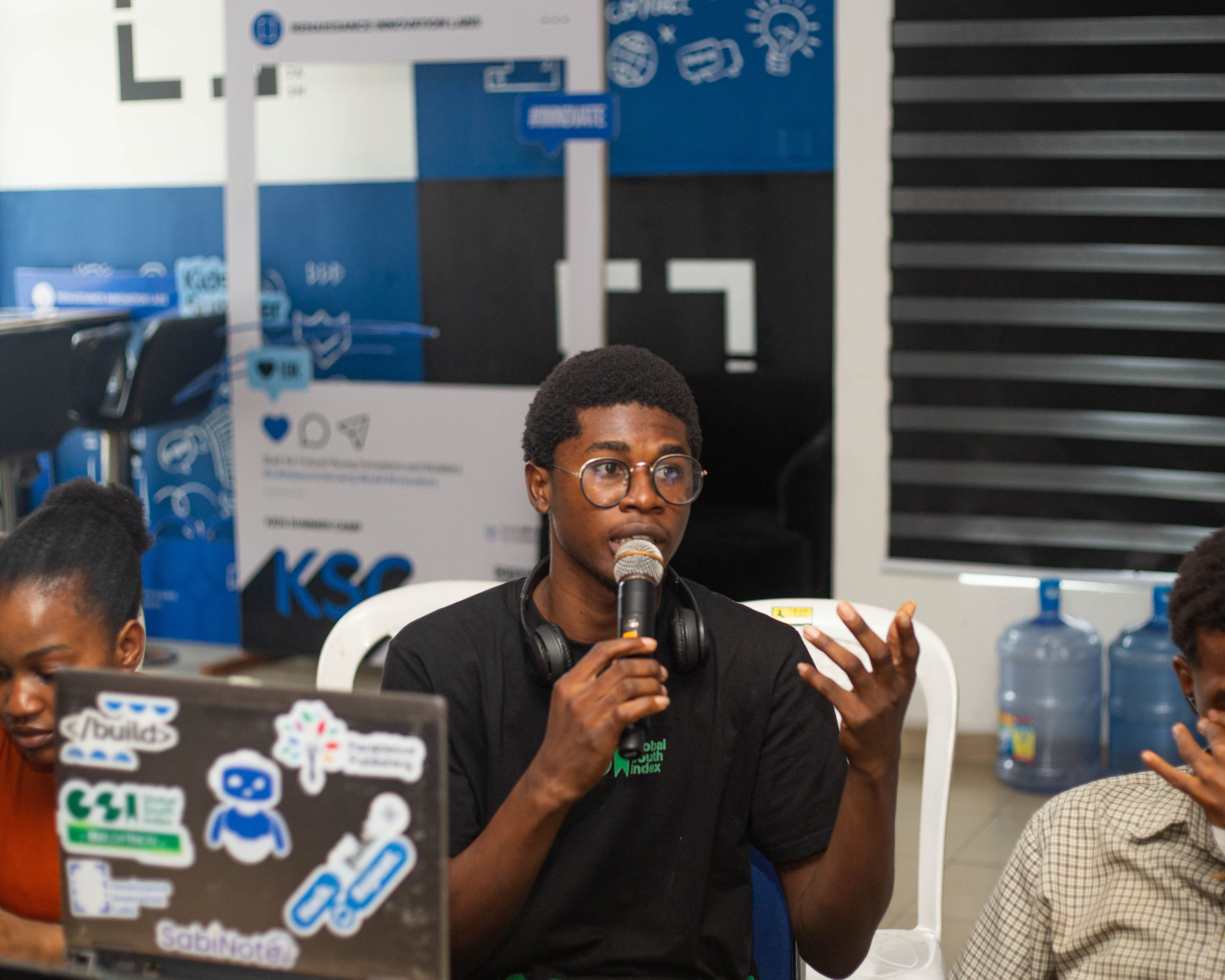
This is where Mr.Boma Amakri stepped in, and this is the moment I will remember longest.
He did not rescue her. That is the important thing. A lesser instinct, a kinder-seeming but ultimately smaller instinct, would have been to wave it off, to say "it's okay, you can sit down, we understand." That would have taken the moment away from her. It would have decided, on her behalf, that she couldn't do it.
Mr. Shammah did the harder and more generous thing. He believed she could, and he built her a bridge to prove it.
He asked her a question. Not a hard one designed to test her, and not an easy one designed to let her off. A steadying one. A question with a clear answer that she knew cold, because it was her own work, her own platform, her own months of building. And when she answered it, still crying, her voice found a half-inch of solid ground. So he asked another. And another. Each question was a stepping stone, placed deliberately just ahead of where she was, close enough to reach.
What he was really saying, underneath the questions, was this: keep going. We are still here. We are still listening. This still matters. You have not lost the room. You are not going to lose the room. Tell us the next part.
And slowly, question by question, something shifted. The tremor in her voice was still there, but the room stopped hearing it as fragility and started hearing it as feeling. The crying didn't stop, exactly. It just stopped being the thing everyone noticed. What everyone noticed instead was the substance underneath it, the sheer clarity of someone who knew her subject completely, who had lived inside the problem long enough to build a real answer to it.
There is a way football commentators talk about the moments that outlast the scoreline. They rarely get poetic about the tap-in, the easy goal, the one anybody could have scored. They save the poetry for the run before it. The moment a player, exhausted, behind, out of obvious options, finds something in themselves in the ninety-third minute that was not there in the first minute or the forty-fifth. They talk about it as if the player has, for one instant, brushed hands with something larger than the game.
That was Taiwo, at that microphone, with Mr. Shammah's questions lighting the path one stone at a time. This was not the story of a smooth pitch delivered by a confident speaker. It was the far better story of a person finding her footing in front of everyone, mid-run, mid-sentence, mid-tears, and finishing anyway. That is the climax of this story, and it is worth naming plainly: the climax was not that she was calm. The climax was that she was not calm, and she finished anyway. She stood in the middle of the hardest version of the moment, and she did not sit down.
Judge Mr. Godfrey, watching all of it from the panel, said afterward what a lot of the room was feeling without the words for it. That she was still standing. Still speaking. Still finishing what she came to finish. In a competition ostensibly about products and platforms and databases, the thing everyone would remember was a person refusing to quit on herself, held up by a room that refused to let her.
What She Actually Built
Now let me do Taiwo the honor she earned by finishing, which is to take her work seriously on its own terms. Because Thread Flow is not a sentimental idea dressed up in emotion. It is a genuinely sharp answer to a real and unglamorous problem, and it deserves to be understood as engineering, not just as a moment.
Fashion and tailoring houses across Nigeria are running serious businesses on tools that were never designed to carry them. This is not a small niche complaint. It is the daily operating reality of thousands of enterprises, most of them run by hardworking people who are quietly buried under operational chaos that has nothing to do with their actual craft.
Consider how a typical fashion house runs. Orders arrive scattered across four different channels at once: WhatsApp, Instagram, Facebook, and the occasional website contact form. There is no single place to see them all. A client messages on one app in the morning and a different one in the evening, and somewhere in that scatter, orders get missed. Client measurements live in physical notebooks, which can be lost, smudged, rained on, or simply misplaced in a drawer under a pile of fabric. Tailors get assigned work based on memory and gut feeling, with no real visibility into who is already overloaded and who has the specific skill the job needs. And the business owner, however diligent, often has no clear picture of which fabrics are running low, which orders are behind, or which client has now been waiting three days for a reply they never got.
None of this happens because these owners are lazy or careless. It happens because they have never had the infrastructure to be anything else. They are running twenty-first-century businesses on tools built for personal chat. Taiwo understood this in her bones, and it is precisely that closeness to the problem that broke her voice at the microphone. She was not describing a market. She was describing a world she knew.
The Four Rooms of Thread Flow
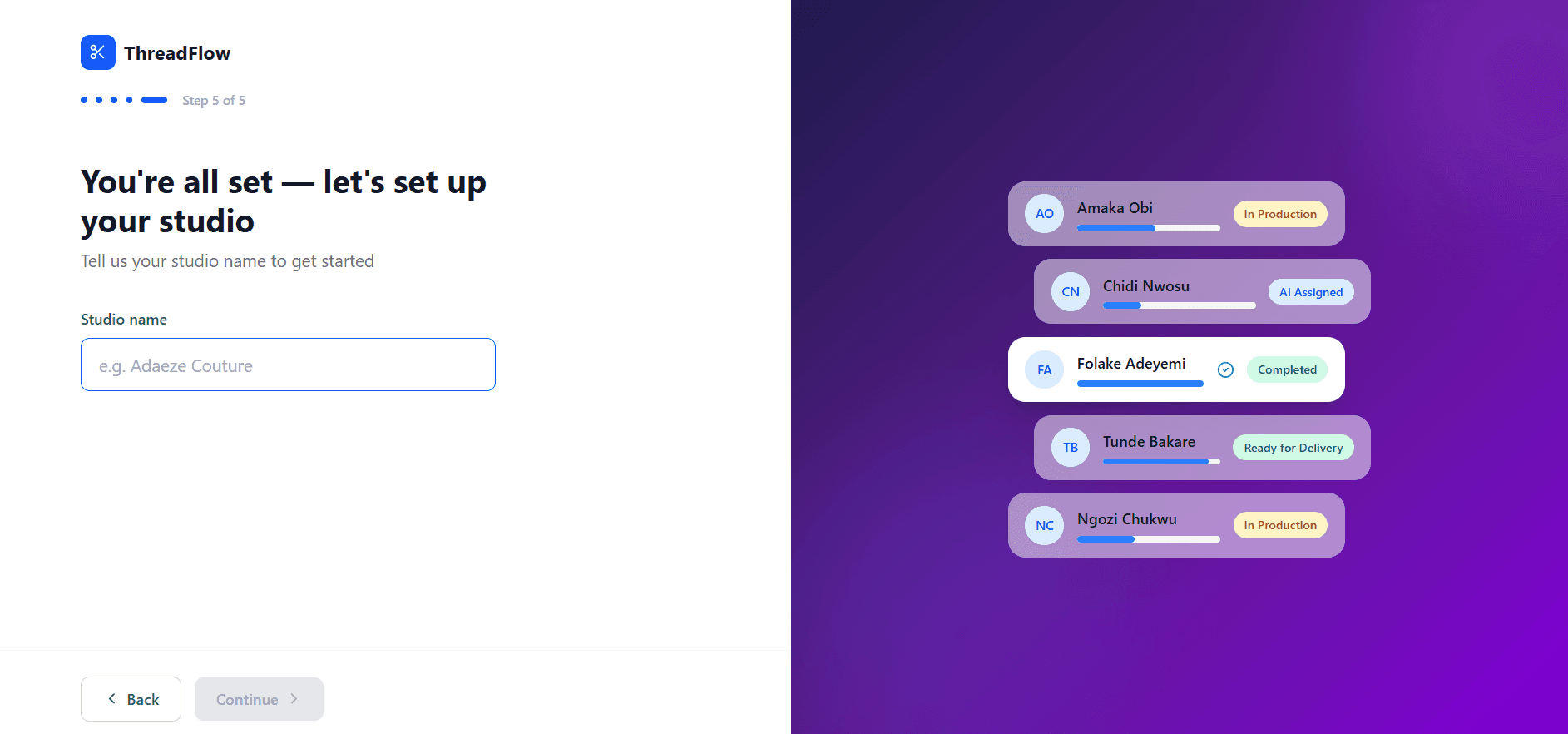
Thread Flow is an operations management platform built specifically for fashion designers, and it is organized around four core pages that mirror the way these businesses actually run rather than the way software companies wish they ran.
The Inbox takes the scattered chaos of client messages across every platform and treats it as a single structured pipeline. Instead of four apps and a prayer, there is one place where every conversation lives, where nothing quietly falls through a crack because it came in on the wrong channel at the wrong hour.
The Order View is where the intelligence begins. It uses AI to assign tailors based on their real, current workload and their specific skills, rather than on the owner's overtaxed memory. The right job goes to the right hands, and the assignment is made with actual information rather than a tired guess at the end of a long day.
The Workforce Tracker makes the invisible visible. It shows, at a glance, who is overwhelmed and who has capacity, so an owner can intervene before a bottleneck becomes a missed deadline and a missed deadline becomes a lost customer. It turns workforce management from a reactive scramble into something you can actually see coming.
The Agent, the command center, is where Taiwo's ambition is clearest. This is an AI tool that reasons across all of the operational data in the system to deliver comprehensive daily and monthly briefs. It does not just store the business's information. It thinks about it, and it hands the owner a clear reading of where things stand.
An AI That Actually Does Things
Here is what separates Thread Flow from the long list of dashboards that merely display numbers and call it intelligence. The AI in Thread Flow does not stop at showing you figures. It is wired directly to a live Supabase database, and it calls on real tools to perform active work.
It checks the store's fabric stock, so inventory is a live fact rather than a guess. It estimates accurate delivery windows, so the promise made to a client is grounded in the real state of the workshop rather than optimism. It drafts replies to clients, so the owner is not starting every message from a blank screen at midnight. And critically, it displays its reasoning chain. It shows its work. When it makes a decision, the owner can see exactly why and how it arrived there, rather than being asked to trust a black box.
That last detail is not a small one. Transparency is what separates a tool a business owner will actually rely on from a novelty they will abandon the first time it surprises them. Taiwo built for trust, not just for flash. That is the mark of someone who understands the people she is building for.
Why the Tears Belong in This Story
It would be easy to write about Thread Flow as pure product. Four pages, a Supabase database, an AI agent with a reasoning chain and a command center. And that account would be completely accurate. It would also miss the truest thing that happened in that room, and it would fail to explain why anyone who was there will remember it for years.
Somebody built something real because she understood, closely and personally, what it feels like to run a business without the right tools underneath you. And when the moment came to say that out loud, in front of judges and peers and friends, she did not perform a composure she did not feel. She let the moment be exactly as hard as it actually was. And then, with a friend in the seats, a judge witnessing from the panel, and a mentor steadying her with one careful question after another, she got through it anyway.
That is the part of building that almost never makes it into a pitch deck or a demo video. Not the polish. The willingness to stand in a lit room, shaking, and finish the sentence.
What RIL Is For
I have thought a lot about that afternoon since it happened, and I keep arriving at the same conclusion about what Renaissance Innovation Labs is actually for.
We are not, fundamentally, in the business of producing polished presentations. We are in the business of producing people brave enough to give them. The product Taiwo shipped that day was Thread Flow, yes. But the deeper thing that shipped was Taiwo herself, a version of her that now knows something she did not know that morning in the corridor: that she can stand in the hardest moment and not run from it.
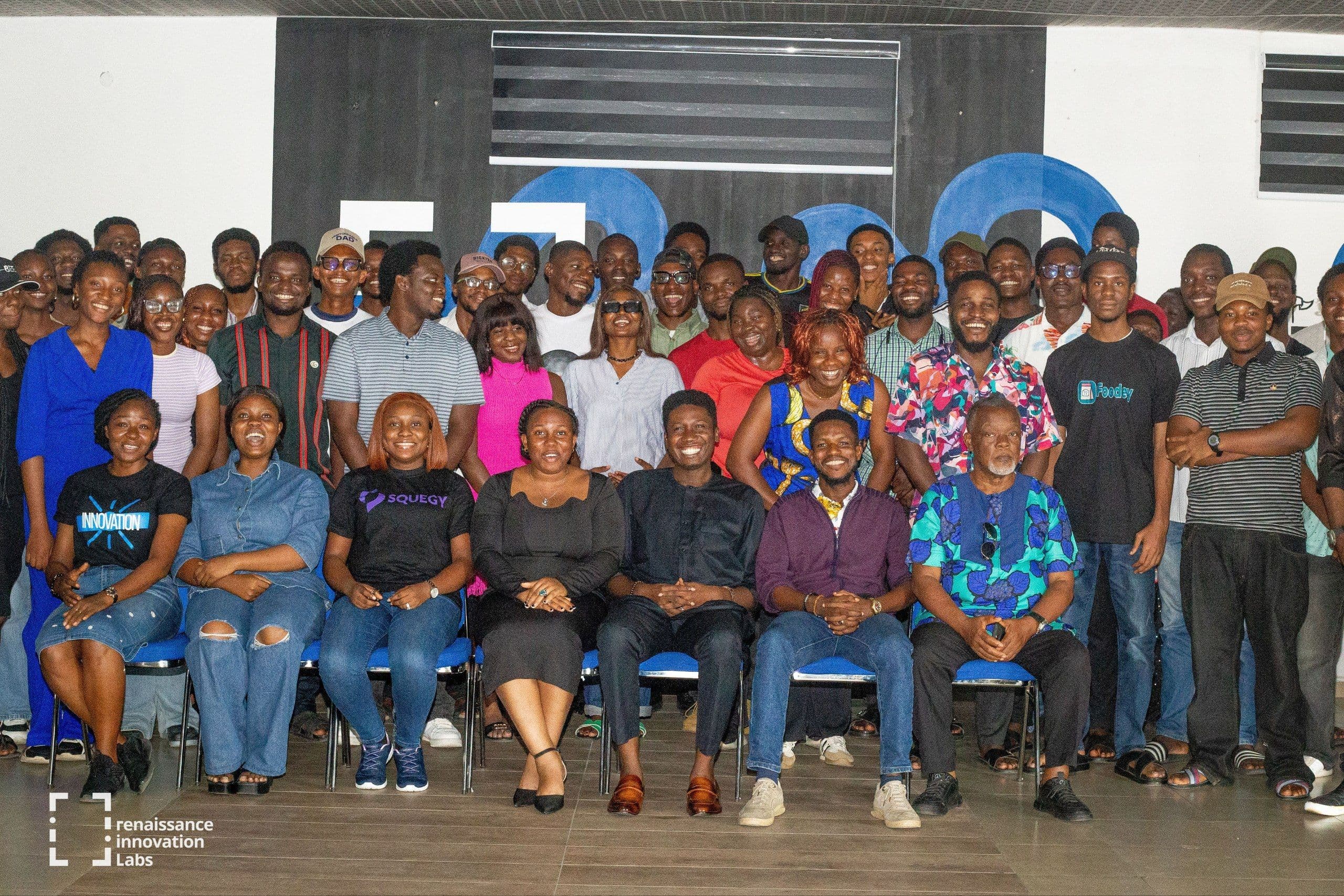
She did not do that alone, and she was never meant to. She did it because when she said she wanted to leave, someone told her to stay. Because when she cried, a room leaned in instead of looking away. Because a friend took a seat where she could find it, a judge chose to witness rather than merely score, and a mentor decided she was capable and then proved it to her with a bridge of questions. That is the RIL community. Not a slogan on a wall. A floor that holds you up when your own legs are shaking.
Taiwo Kolawole walked into that corridor wanting to leave. She walked out having finished. And the distance between those two things is the entire reason we do what we do.
She stayed. She spoke. She finished.